
Last night I was invited to attend the first of a global series of "Claude Conversations" - where people from across the community are asked to discuss the question "What is AI doing to me, my kids, my community?"
Just by the nature of the event, most of the people who signed up and attended would identify as early adopters - and broadly positive towards AI - but it felt like there was still a pretty good range in terms of demographics, roles and backgrounds. There had been a short questionnaire set when signing up, and attendees had been selected as likely to add to the conversation, based on the answers they gave. Groups were roughly 7-8 people, balanced so that there was a split between technical and non-technical folks - it seemed that roughly ⅓ of the people were engineers - but otherwise formed at random.
The conversation itself was split into two halves - the first part discussing the question in detail, and the second part proposing a shape for solutions. The goal being to feed these suggestions into an upcoming hackathon - the Claude Impact Lab - where teams will look to build solutions.
There was a set of instructions, and further questions to help prompt the conversation:
- Go around the table first — your name, what brought you tonight, and one place AI has touched your home or neighborhood.
- 01 - What is this question really asking?
- Every big question hides smaller ones. What's underneath this one — and what would a good answer even look like?
- 02 - What does this mean for us, here?
- What is changing in our homes, schools, and streets — the good, the bad, and the not-sure-yet?
- Whose story here surprised you?
- 03 - What are we hoping for — and what are we afraid of?
- A fear named out loud shrinks; a hope named out loud grows.
- 04 - What could be done about it?
- By anyone — a person, a school, a city, the world. The silly ideas loosen up the real ones.
- 05 - What stands in the way?
- Time, money, know-how, permission, trust — the quiet one is usually the real one.
- 06 - So — where do we start?
- Of everything said tonight: what's small enough to start, and big enough to matter?
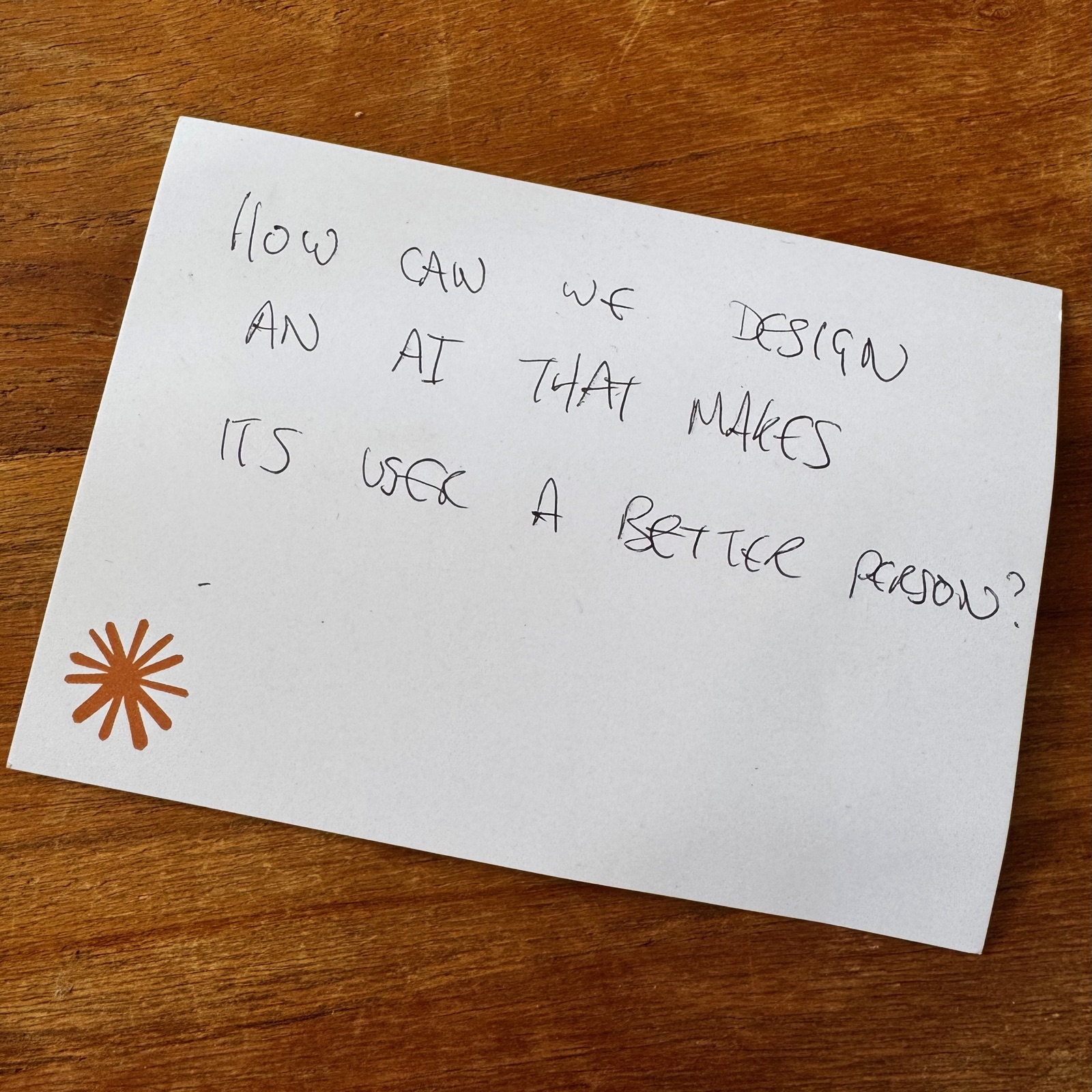
The output from my group: the card above - "How can we design an AI that makes its user a better person?"
This stemmed from an observation that those of us in the group doing agentic coding were explicitly building skills and sidecars focused on helping us become better developers, and not just getting the AI to write code to achieve our goals. Throughout our conversation, there had been pushback on using AI as simply a black box tool for generating outputs - of varying quality. What if, instead, it could be harnessed to help users understand what makes different outputs better or worse?
We'd also started our conversation with a couple of folks saying that the first thing they did with Fable was ask it to review all their previous conversations, and provide a profile back to them. There were caveats and concerns, but in this way too, we could start to see an interesting path.
Along with introductions, our discussion started around what we see in the local community - with an observation that largely AI was talked about, but not really visible. The one exception that stood out was posters for local events, something of a trending topic on some corners of the internet. There were comparisons with prior generations of folks playing with Publisher - and whilst visible, it largely didn't feel like this was particularly impactful in and of itself. But this did lead us into the topic of 'slop' creation, in particular in a working context, and the people who just prompt, then cut and paste the outputs. It was noted that this approach has introduced an imbalance; there have always been those who deal in bullshit, and those who pad their work – but it is made many times worse by the increasing difference in the time it takes to 'create and share' something, versus that required to 'consume and understand.'
In discussing different approaches to handling the volume of generated content, skills-development was highlighted as another area of concern, and there was a lot of talk about the trade-offs between hiring more junior folks and investing in their development, relative to making the most of a few more seasoned people. Some of the concerns stem from noting struggles they have observed in younger team members who don't have the same grounding, and are not able to effectively critique the content that AI produces. The key question was how to enable folks like this to bridge the gaps, when the knowledge needed to do so may have a very short shelf life.
One participant shared how they have been redoing their lawn, and the sense of pride they have in having put the work in. This led to a discussion about value - and how our approaches to valuing something have shifted from measuring inputs, to outputs, to outcomes. We talked of a distinction between value-to-self, and value-to-others - and how those two may be brought closer together.
I had shared that my own children (15yrs and 20yrs) are not very enthusiastic about AI - and don't really use it for their school work or studies. This surprised everyone. Particularly given my background, and their exposure to how it helps their mother run her businesses (as a non-native English speaker, she relies on it for web copy, and help with customer support, as well as refining her Shopify setup). In part, I think this is not a particularly anti-AI stance, so much as a broader distrust of the corporations and institutions that cheerlead it. There's a more general disillusionment, as they see the profit motive take precedence over everything else - and they are deeply skeptical of any bargain that companies offer.
Much of the middle of the conversation, then, identified big systemic issues - particularly those around the nature of capitalism itself, and a concern that the current distribution of AI / productivity benefits skews too much towards companies. No-one around the table felt they were currently working less, or otherwise receiving a share of the rewards - and we briefly touched on the Luddites, and Brian Merchant's Blood in the Machine.
We felt that one way to even out these imbalances might be to build tooling so that there's an intrinsic benefit to the user when using AI - that through the act of interacting, the person learns more about the domain in which they are working / exploring.
In the limit, we also felt that perhaps the best way that AI can help us to tackle things at a societal level is through this 'levelling up' of the populace. Of course, this leaves open all sorts of questions: What incentivises this approach, when 'just get the job done' may be cheaper in the short term? Who gets to decide what 'better' is, and in which dimensions? How do we avoid those in power using this approach simply to further consolidate their power? But it's perhaps a start, and we can bootstrap from there.
With thanks
Thanks to Max Tatton-Brown and the Claude Community for pulling the evening together, and to the folks at Marker for hosting.
And thanks to the rest of my group — Evelyn Tan, Jonathan Roomer, Kairavee Paul, Sagar Haria, Caroline Jaworsky, and Alice Jin — for a genuinely thoughtful conversation; one I hope is the first of many. The thinking above is theirs as much as mine; but what I've captured is my own read of where we got to, and any errors or omissions are mine alone.